Chapter-5
Black-Edges Sorcery Chapter-5: The Upstairs Apartment
Dong Yang wore a striped shirt and another pair of glasses as he led Zhang Ming and Zhang Xinyi up the Cold War-era stairs. The staircase was dark, with paint chipped off the walls in places and a layer of rust on the handrail.
“It’s on the topmost floor. This building was built by the Ministry of Water Resources, and many of the old residents still living here used to work for the water resources department. The water pressure in this building is the best in the city,” Dong Yang said.
“I thought you would prefer an apartment built by the TV broadcast station. Wouldn’t they have a better internet connection?” Zhang Ming said.
“Ha ha ha, really funny. The only difference is that they had 2 Mbps broadband pulled in about two years earlier — around 2005 instead of 2007. They do indeed have a better location compared to here. But here we have toilets and water on the base floor. Other than that, there’s no real difference,” Dong Yang said.
“Shouldn’t the apartment built by the TV station have better internet?” Xinyi asked.
“Nope. Unlike piping, all fiber networks are pulled by either Broadnet or the telecom companies. And the fiber is pulled long after the building was built. Piping, on the other hand, was built by the department back in the day. The Ministry of Water Resources would have better-made, better-designed pipes,” Dong Yang said.
They arrived at a thick metal blast door, a popular type of door in the early 2000s. Dong Yang opened the door and switched on the lights before inviting Zhang Ming and Xinyi inside.
The apartment was almost empty — a sharp contrast to the tiny, packed base floor. Even the ceiling was a bit higher, being the top floor. The floor was made of cut marble. There was no sofa or couch, no coffee table, no TV cabinet — just a bare 75-inch TV lying on the floor, and a few boxes of computers flashing green and red LEDs.
“There are folding chairs in the storeroom — let me get them,” Dong Yang said.
Xinyi walked around the bedrooms. There were two double beds in each of them. One room had a PC with a monitor and speakers, a full-length MIDI keyboard with “Alesis Q88” written on it, and a Wacom screen on a stand.
In the other room there was a transparent whiteboard made of glass, with papers taped on top. Many mathematical formulas were written on the papers.
“Dad, can you understand that math?” Xinyi asked, pointing at the papers on the glass whiteboard.
“Let me see… Nope. I think this is Big Theta notation, used to calculate algorithms,” Zhang Ming said.
“You’re right, they’re Big O notation. Some people also call it Theta notation — they mean the same thing outside computer science academia anyway. It’s used to calculate time complexity. But now those are just waste papers. I couldn’t even read them myself now,” Dong Yang said.
“That’s a large whiteboard. Those were rare even in big companies,” Zhang Ming said.
“Ah, the worst purchase of my life. A fully darkened laminated-glass whiteboard with hardwood legs. That thing weighs over a freaking 60 kg, and it has no magnets. It looks cool with fluorescent markers. And with its price tag and the nature of the material, it needs careful handling. Also, this thing is 1.8 m tall and 1.5 m wide — a pain to move through doorways,” Dong Yang said.
“It’s just an overpriced notepad. I have the chairs ready — come and have a seat,” Dong Yang added.
The two of them took their seats.
“Uncle Dong, do you play music as well? I saw a piano in the bedroom,” Xinyi asked.
“Ah, that’s not a piano — it’s a MIDI keyboard. It used to cost a fortune back in the day when it was popular. Not so much now. Well, you can still connect it to a phone and use it to play the harp in Genshin Impact,” Dong Yang said.
“So let me guess — the Chinese manufacturers cut the price down?” Xinyi guessed.
“Not really. The demand died down, or the hype cooled off. Back in early 2011, MIDI keyboards and synthesizers were popular — even software like Virtual DJ was a big hit. It was also the year everyone was pirating DAW software, to the point that even box art like Hatsune Miku got popular. You can totally imagine the price of a MIDI keyboard back then. Everyone was trying to learn a thing or two about music,” Dong Yang said.
“With the atmosphere of the internet back then, as long as you could ride the current, you’d get pretty good at mixing and track editing — or even playing the piano. I learned my music fundamentals back then too: tempo, time signature, key signature, root position, tonic, supertonic stuff. But with no real education and no tests. Those were some good times,” Dong Yang added.
“Ah, Hatsune Miku. I like her too — I find her cute as well,” Xinyi said.
“Yeah, the figures still live, but the spirit of writing songs and making music is gone. Though I must say, the people who make MMD have it easy programming humanoid robots now. Even in robot MMA, they dance better than they fight,” Dong Yang said mockingly.
“Ah, I didn’t know those dancing robots are so similar to the humanoid ones. No wonder their dance moves look so smooth compared to combat,” Xinyi said.
“Yes, I was shocked to hear that from my friend, who makes MMD as well. I thought those who program MCUs had the upper hand, but they said those guys can’t get the movement done. Too bad — I didn’t have much interest in MMD back in the day,” Dong Yang said.
“That’s actually surprising. I thought back in the day you would dive head-first into technology like that,” Zhang Ming said.
“Back then there were too many things — AI n-gram, music software like Cubase and Virtual DJ, and digital art like CLIP STUDIO PAINT. There had already been investment in MIDI keyboards and Wacom tablets, plus music theory and all that. Life was packed even for my younger self,” Dong Yang said.
Dong Yang got a fresh set of bedsheets from the cabinet.
“There are fresh toothbrushes and toiletries in the washroom. The PC password is written on a sticky note on the PC casing,” Dong Yang said.
“Daily necessities can all be handled within the neighbourhood, but you might still want an electric moped. I do have an extra bicycle, if you know how to ride one,” Dong Yang said.
“Don’t worry about that — I was planning to get her a moped anyway,” Zhang Ming said.
“It’s getting late, and the roads should be closed by now. Do you need help carrying the PC home?” Dong Yang asked.
“No worries. Is the OS already installed, or do you do a fresh install?” Zhang Ming asked.
“Nope, I don’t. The shop on the main road does it for 10 yuan — about the price of two or three cans of coke. But the current operating system is fine,” Dong Yang said.
“No — I was thinking of running this computer as a Linux server. Those shops won’t do. I couldn’t even get the operating system connected to the internet if I did it myself,” Zhang Ming said.
“Ah, Broadcom and Realtek issues back in the day. That’s fixed now — most ethernet and wifi are plug and play and don’t need extra setup. I can still help you if you’re still worried,” Dong Yang said.
Author’s note:
The TV broadcast station is the predecessor of 中国广电 (China Broadnet). It used to work only with wired TV — Ezhou, although small, has its own TV station. Today, when TV is unimportant, they also work with fiber broadband. Older cellular network providers only have cell towers — they were never wired into every home. Funny enough, home telephones weren’t popular either: public phone stands were still a thing even when every family already had a color TV. It was the TV cable that reached every household — which is how the TV-station side could offer broadband early.
In the planned economy era, city flats weren’t bought — they were built and provided by your work unit (单位). Ministries, factories and institutions built dormitory buildings for their own staff, and allocated the flats by a points system — seniority, rank, family size. The work unit built the infrastructure too, not just the homes — which is why this water-department building still has the best water pressure in the city. The practice (福利分房) ended in 1998, when housing became something you buy — but many of the original workers are still living in the flats they were assigned.
MMD: Miku Miku Dance, software used to make 3D models dance in videos. Because of its nature, its skills closely resemble those of humanoid robots. In fact, MMD files contain joint rotations.
Dong Yang has Level 5 music theory. It’s a common level of music theory for writing and reading scores for someone who is self-taught in music theory.
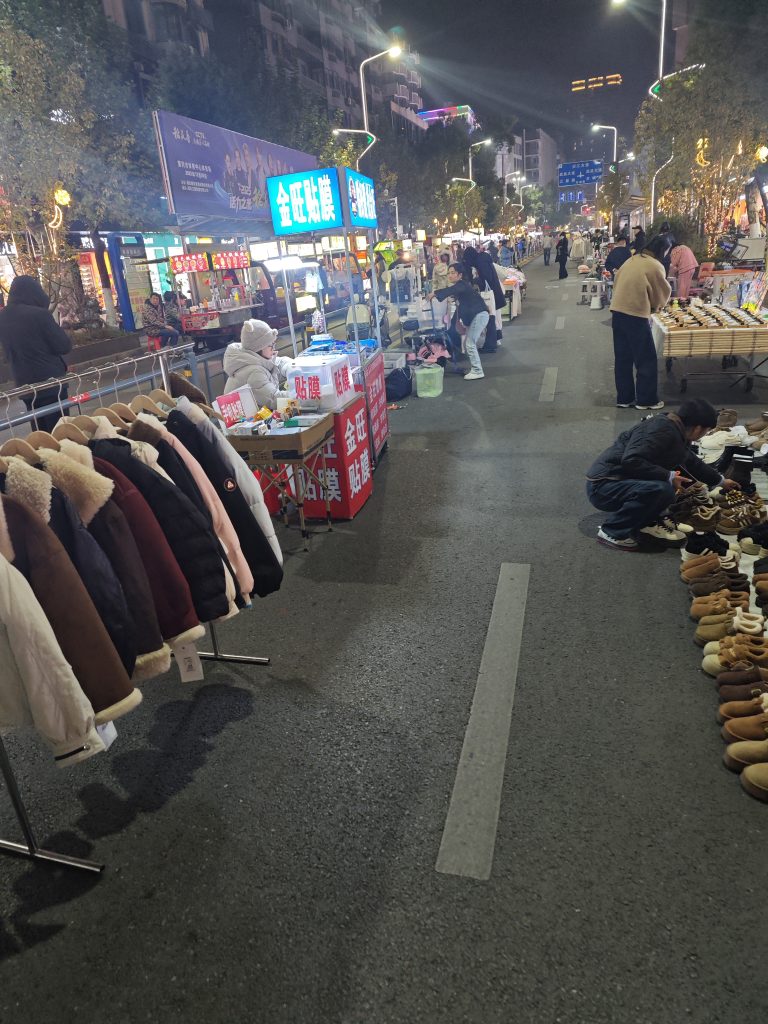
Ezhou closes roads. The main road in Ezhou is closed from the evening until late at night, to boost the local economy — there are street stalls along it. A real photo of Ezhou, with the road closed even in winter: