Chapter-3
Black-Edges Sorcery Chapter-3: Hex and AI (EEPROM and soldering)
“BIOS is such a unique case — software that behaves like hardware — that a new term was invented for it: firmware. The word sits between soft and hard. Think of it as a molten state between solid and liquid,” Zhang Ming said, following up on his earlier answer. “Back when I was your age, I was already fixing my PowerPC.”
“There were people back then who thought they could download more RAM too,” Dong Yang said, defending Xinyi.
“True…” Zhang Ming made an awkward smile.
Dong Yang stood up, took a notebook and a pen, and sat back down, seeming to count something.
“Uncle Dong, so this is what BIOS is? Can you read those codes?” Xinyi asked.
“I can’t. At least, I don’t know any human who can read hex. They’re not meant for human reading. I’m just guessing from experience where the whitelist is, and doing some counting…” Dong Yang replied.
“So Dong Dong can read those codes?” Xinyi asked.
“No. AI uses vectors — only language and words carry meaning and vectors. Hexadecimal is like an individual letter that has no meaning in itself, so it carries no vector. For example, A5 could be anything: a paper size, an opcode, or part of an address, before it’s ever a hexadecimal code. So Dong Dong can’t read it either,” Dong Yang explained.
“Although I can’t read it the way a human does, I can analyze known patterns — like the whitelist. That saves time on the guesswork. Would you like me to do that now?” Dong Dong’s voice came through the wall speaker, gently correcting him.
“Wait — what? So you can basically read hexadecimal?” Dong Yang suddenly asked, his voice cracking in shock, his eyes wide open.
“Yes. My training data includes tutorials on hexadecimal and BIOS editing. Although I can’t write a whole BIOS by myself, I can find known patterns that resemble the whitelist,” Dong Dong explained.
“Go ahead and do that now. I’ll get the soldering ready — I guess we won’t be using the clips this time, probably,” Dong Yang said.
“Dad, why is Uncle Dong so surprised that Dong Dong can read this hex? Isn’t AI writing code a common thing now?” Xinyi asked her dad.
Zhang Ming shrugged, unsure of the reason himself, but after some deep thought he said, “My guess is that another group of people in the tech industry will soon get replaced by AI, and it may be quite a big deal.”
“Is Uncle Dong going to get replaced by Dong Dong soon?” Xinyi asked, curious.
“Hahaha. You really thought your Uncle Dong did PC repairs for a living, didn’t you? People like him would rather stay unemployed than do something like that,” Zhang Ming said. “Your Uncle Dong used to be at the frontier of machine learning.”
“And do you expect a city this small to have a tech industry? Last year a 78M05GN voltage regulator burned out on me, and I had to travel to Wuhan to get it fixed. The tech industry in Ezhou is non-existent. This isn’t Shenzhen, where Uncle Dong would have more than enough orders for EEPROM BIOS fixing,” Zhang Ming continued.
“Wait — fixing a 78M05GN burnout? That’s one of the most common faults there is. You mean the whole of Ezhou doesn’t have a single person who does electrical soldering?” Dong Yang was surprised that Zhang Ming couldn’t find anyone in Ezhou to fix it.
“Oh, I went to every PC repair shop in the city — both the old and the new districts. No one does soldering; it’s all parts swapping. I was surprised too. That would have been an easy task for anyone with a soldering iron,” Zhang Ming said. “Xinyi should learn some soldering from you as well, since you have a hot-air rework station and a soldering iron here.”
“I’m afraid not. All I have is Senju M705 wire — lead-free, no rosin core, and it wants the iron at 400 degrees. The Hirosaki 60/40 has a rosin core, but it also wants the iron at 400. Nothing beginner-friendly here… and the JF-333AC paste has gone hard. It should have been stored at two to ten degrees Celsius, and of course it just sat on my shelf… Damn it, those things are expensive,” Dong Yang complained.
“Don’t you have something cheap? Like the generic soldering wires?” Zhang Ming asked.
“Nope, at least not at my place. It’s microelectronics — the contact area between components is tiny. The last thing you want is for them to come loose and break the contact. And at 400 degrees, an inexperienced hand can easily damage the board,” Dong Yang explained.
“Ah… it still hurts, thinking about how much I spent on the Jufeng soldering paste,” Dong Yang said, thinking back.
“Do those cost a lot?” Xinyi asked.
“A lot of those things might not seem to cost much, but the price of some of them has no upper limit,” Zhang Ming said.
“Yes, good paste costs a fortune, especially from a well-known metallurgy company — Jufeng is one of them. Expensive things are also delicate. They need to be sealed and kept in a controlled environment, dry and cool — two to ten degrees,” Dong Yang added.
Dong Yang sat beside the cleared-up part of the table and preheated the precision soldering iron all the way up to 400. He then dug a can of flux out of nowhere from the messy part of the table, as if he was used to the piled-up mess. He also brought out a roll of Kapton tape from a different spot in the pile.
“The Kapton tape has lost its stickiness — it’s long past its shelf life. But it should work either way,” Dong Yang complained.
After a beep from the soldering station, indicating the temperature was ready, Dong Yang turned on the table lamp.
“Wait, there was a table lamp on the table?” Xinyi looked at Dong Yang, who was starting to solder.
“It’s always like this. Your Uncle Dong works in an orderly-disordered manner. He can keep a team organized in an even more disordered environment,” Zhang Ming said, answering Xinyi’s doubts.
“You can learn computing from him, but there are also things you shouldn’t learn…” Zhang Ming continued.
“Ah haha. If you learn my way of living, you’ll be single for life — which might be a good thing,” Dong Yang said in a joking tone, totally unaffected by Zhang Ming’s remarks.
Dong Yang began taping down the components around the WSON8 flash chip.
“It should be done in one minute. Back when WSON8 first replaced SOP8, this was a nightmare for everyone,” Dong Yang recalled.
“A motherboard has so much space. I never really got why components should get smaller. There needs to be only one EEPROM chip anyway. Look, there’s plenty of space around the WSON8 — big enough to even fit a full-sized DIP8,” Zhang Ming complained while watching Dong Yang carefully remove the tiny WSON8, a chip his eyes could barely make out.
“Oh, WSON8 uses less resin on the cover, so it’s technically cheaper to manufacture. They probably save a yuan for every million units, before a few of them get lost in production,” Dong Yang said sarcastically.
“It’s removed. Now, to keep the old WSON8 BIOS chip from getting lost, we need to solder it onto a blank adapter PCB. It’s hard work with my 1200-degree glasses,” Dong Yang said without his hands stopping.
“It’s done. While we wait for Dong Dong to pick up the whitelist, you could help me remove the switches from a keyboard if you want to practice soldering. It’s a through-hole circuit — I have a desoldering tool here,” Dong Yang said, heading to one of the shelves and coming back with a stack of keyboard PCBs.
“Don’t worry, they’re all dead PCBs now. Back then switches were expensive — now they’re worth nothing, to the point that keyboard manufacturers even send plenty of them out for free. Zhang Ming, don’t just stand there — show her how it’s done,” Dong Yang continued.
Zhang Ming applied a bit of flux and used the soldering iron to heat up the solder on the PCB.
“That won’t do. Those joints were made by an automated soldering machine — lead-free solder, no rosin, no flux. Similar to the Senju M705. You need to put a lot more flux on the PCB and really heat the copper pads until the board itself is on the edge of burning. Through-hole circuits are difficult to remove,” Dong Yang explained while watching Zhang Ming.
After a while and some struggling, Zhang Ming finally removed two of the switches.
“It was a lot harder than I remembered,” Zhang Ming said.
“That’s how things normally are. Electronics are soldered by machines, and those expensive machines need expensive solder wire — like the Senju M705 I have. It’s a different type of soldering from DIY and prototyping. It’s difficult to use even for people with soldering experience. Xinyi is still too early for soldering work like this — it would just diminish her motivation,” Dong Yang explained.
Author’s notes:
For readers who want to try learning soldering, please don’t be like Dong Yang. Solder wire from well-known metallurgy companies is expensive, and it can be hard to use, as it usually comes with no flux core and may need a precision soldering iron. Soldering paste also needs a controlled environment, and its shelf life is really short. Good pastes like the Jufeng one Dong Yang uses have no listed prices. Cheap rosin-core solder wire, like 60/40 tin-lead, is a much better choice for beginners or prototyping.
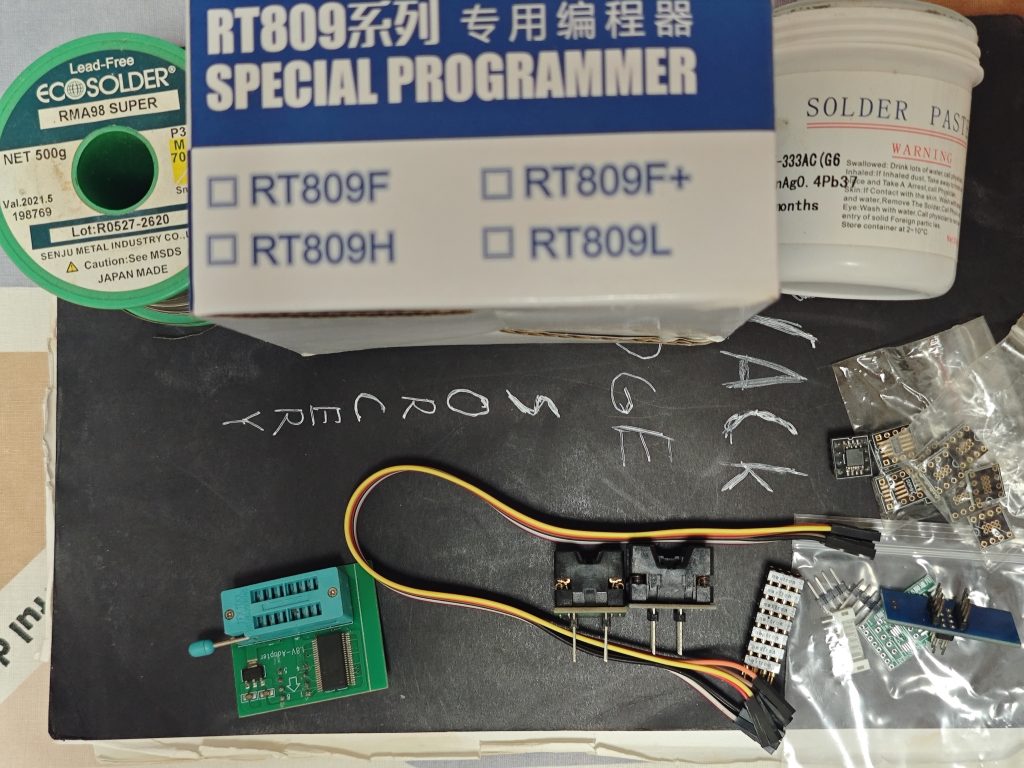
From left to right: Senju M705, RT809, Jufeng soldering paste (the jar that dried shut). Bottom: 1.8 V adapter, DuPont cable, and assorted adapters.